
Sosoactive: Complete Guide to Its Business Content, History, and Reader Value
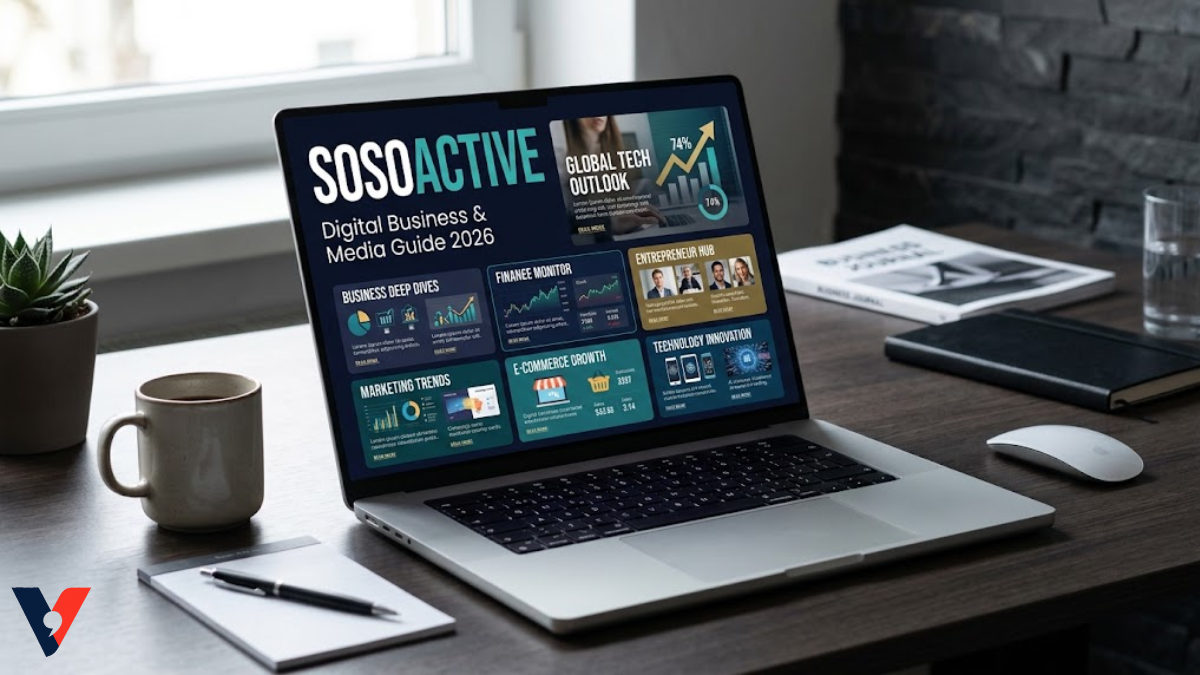
Sosoactive is currently best understood as a business-focused digital publication rather than a social network, streaming service, or single-purpose software platform. As of September 2026, its main website publishes material across business, finance, entrepreneurship, marketing, e-commerce, and IT, aimed largely at readers looking for ideas, explanations, and practical guidance.
The name has a longer history than the current homepage suggests. An older public company profile describes SoSoActive Media as a Dallas-based interactive media company founded in 2011 with a focus on social and mobile music.
That distinction matters. Anyone researching the brand today needs to separate the current publication, the historical media identity, and unrelated or separately operated websites using similar names.
What Is Sosoactive?
The current .com website is an online business and information publication. Its homepage describes the site around business ideas, strategies, trends, and resources for entrepreneurs and professionals, while its navigation organizes articles into six main areas: Business, Finance, Entrepreneurship, Marketing, E-commerce, and IT.
It works more like a digital magazine than a software product.
Search Query
↓
Choose Relevant Category
↓
Open Article or Guide
↓
Check Author + Publication Date
↓
Evaluate Evidence and Context
↓
Apply Useful Information or Research Further
The distinction is useful because search results for this name can lead to several domains. For example, .net currently describes an active-lifestyle and guest-post operation, while .blog presents itself around technology, social media, business, finance, and education. Those descriptions should not automatically be treated as evidence that the sites share the same ownership or editorial operation.
Why Is Sosoactive Important?
Its practical value comes from the range and accessibility of its editorial material, particularly for readers who regularly move between commercial and technology subjects.
- Cross-functional reading: An entrepreneur can move from financing questions to marketing execution and online-store operations without changing publications.
- Idea discovery: Broad editorial coverage can expose readers to business models, consumer behavior, software concepts, and operational problems they may not have actively searched for.
- Recent publishing activity: The homepage displayed articles dated through September 25, 2026 when checked, showing that new material is still being added.
- Practical framing: Many visible headlines are structured around recognizable business decisions rather than academic theory.
- Accessible starting point: General explanations can help a non-specialist understand terminology before moving to technical documentation, regulatory material, financial filings, or specialist research.
- Multiple professional angles: Founders, marketers, online sellers, managers, and technology readers can approach the same commercial issue from different perspectives.
The site is most useful as a research starting layer. High-stakes financial, legal, medical, tax, or security decisions still call for authoritative primary sources and qualified professional advice.
Quick Reference Matrix
| Core Element | Action / What It Involves | Primary Goal / Output |
| Editorial navigation | Select a subject-specific archive | Reduce irrelevant reading |
| Article timestamp | Check publication and update dates | Judge recency |
| Author byline | Identify who prepared the piece | Establish accountability |
| External references | Open important supporting links | Verify major assertions |
| Commercial language | Separate education from promotion | Detect possible bias |
| Search relevance | Match the article with your exact question | Avoid intent mismatch |
| Secondary research | Compare sensitive claims elsewhere | Build confidence before acting |
| Notes | Record figures, names, tools, and unresolved questions | Turn reading into usable research |
How to Use the Platform Effectively: Step-by-Step Deep Dive
Step 1: Confirm the Exact Domain First
Do not rely on the logo or brand spelling alone.
Several websites use closely related versions of the same name. The domain in the browser address bar is therefore part of the identity of the source, not a minor technical detail.
- Read the full hostname before trusting a result.
- Confirm whether you are on the .com, .net, .blog, or another extension.
- Look for a consistent About, Contact, Privacy, and author structure.
- Treat claims made by one domain as belonging to that domain unless ownership links are explicitly documented.
- Recheck the address after following redirects or external links.
This takes seconds and prevents a basic research error: combining separate publishers into one assumed organization.
Step 2: Translate Your Question Into the Right Editorial Section
Broad sites become much easier to use when the query is classified before reading.
| Your Question | Best Starting Section |
| How can a company increase sales or improve operations? | Business |
| How does a funding, lending, pricing, or money concept work? | Finance |
| How can someone launch or structure a new venture? | Entrepreneurship |
| How should a company acquire or communicate with customers? | Marketing |
| How does an online selling model operate? | E-commerce |
| How does a software or technical business system work? | IT |
This approach reduces random browsing.
A search for customer acquisition, for instance, may require Marketing first. A question about building the store itself belongs closer to E-commerce or IT.
Step 3: Inspect the Article Before Reading It Closely
A professional research habit begins above the first paragraph.
Check four pieces of metadata:
- Publication date — Is the subject time-sensitive?
- Author — Is a clear byline present?
- Category — Does it match your reason for visiting?
- Headline scope — Is it an explanation, opinion, comparison, tutorial, or commercial piece?
Then scan the page for named sources, examples, measurements, screenshots, calculations, official references, or first-hand observations.
A polished article can still contain unsupported assumptions. Formatting is not evidence.
Step 4: Apply a Higher Verification Standard to High-Stakes Claims
Not every statement needs the same level of proof.
A productivity idea and a claim about investment returns should not be evaluated identically.
Use this verification ladder:
- Low-risk idea: Check whether the reasoning makes sense.
- Product or software claim: Verify specifications on the provider’s documentation.
- Market statistic: Find the original research organization or dataset.
- Financial claim: Check regulatory documents, official filings, or qualified financial sources.
- Legal or tax claim: Consult the relevant government authority or licensed professional.
- Health or safety statement: Prefer recognized medical, scientific, or public-health sources.
Google itself advises giving particularly strong attention to trust for information that can materially affect financial stability, health, safety, or broader well-being.
Step 5: Audit Outbound Links Before Following Their Advice
Links can perform different jobs.
One may document a factual claim. Another may simply direct readers toward a commercial service.
For every important outbound link, ask:
- Who owns the destination?
- Does it contain original evidence?
- Is the linked page selling something?
- Does the destination independently support the statement?
- Could the same fact be checked through a primary source?
Pay special attention when an article moves quickly from discussing a problem to recommending a single supplier.
Commercial involvement does not automatically make information wrong. It does change the level of scrutiny the recommendation deserves.
Step 6: Turn Useful Reading Into an Action File
Do not save entire articles and assume you will remember the useful parts later.
Build a compact research note.
Recommended format:
- Question: What was I trying to solve?
- Finding: What new fact or concept did I learn?
- Evidence: Which source supports it?
- Date sensitivity: Could this information expire?
- Business impact: Revenue, cost, risk, efficiency, or knowledge?
- Next check: What still needs independent confirmation?
- Action: What decision, experiment, or discussion follows?
That method converts passive reading into decision-ready information without treating a single publication as the final authority.
Industry and Use-Case Specific Scenarios
For a First-Time Founder
A new founder can use broad business publishing to build a problem map before paying for consultants or software.
Suppose the company is struggling with repeat purchases. One article might introduce retention economics, another could expose a customer-communication method, while a third may explain an e-commerce tool category.
The outcome is not an instant strategy.
The useful output is a better set of questions for the next meeting, vendor demo, or experiment.
For an E-commerce Operator
Online retailers routinely make decisions involving merchandising, fulfillment, payment systems, advertising, returns, pricing, and conversion.
A general publication can surface ideas outside the operator’s usual specialty.
A store owner obsessed with paid ads, for example, may discover that the larger constraint sits in checkout friction or weak unit economics. Reading across disciplines helps identify those cross-functional dependencies.
For an In-House Marketing Team
Marketing professionals can treat editorial sites as a topic-discovery layer.
The strongest use is not copying someone else’s article structure. Instead, track recurring customer concerns, unfamiliar terminology, new software categories, competitor behavior, and commercial questions appearing across multiple sources.
Those observations can feed:
- editorial calendars;
- customer interviews;
- sales enablement;
- FAQ development;
- original research;
- product positioning.
The final material should come from the company’s own expertise, data, examples, and customer evidence.
For Finance Readers
General finance articles work well for understanding the shape of a subject before moving into primary documents.
A reader encountering an unfamiliar investment term can first learn the vocabulary and relationships between concepts. Before committing money, the next layer should include filings, prospectuses, regulator guidance, audited reports, fee schedules, or qualified professional advice.
That two-layer approach separates learning from decision-making.
For Technology Managers
IT managers rarely need another collection of random product names.
They need a shortlist built around requirements.
A useful article might reveal a type of system worth investigating. The manager can then convert that discovery into a technical evaluation covering security controls, integrations, data ownership, uptime commitments, export options, support, total cost, and deployment requirements.
The publication supplies the lead.
The procurement process supplies the proof.
Historical SoSoActive Media vs Current Sosoactive.com
One of the biggest sources of confusion around the term is the difference between its documented historical identity and its present website format.
| Factor | Historical SoSoActive Media | Current .com Website |
| Public description | Interactive media company | Business-oriented digital publication |
| Documented era | Founded in 2011 | Active in 2026 |
| Historical base | Dallas, Texas | Current homepage does not use the old Dallas positioning as its central identity |
| Main subject | Social and mobile music | Multi-topic commercial information |
| Historical specialties | Music marketing, social media marketing, advertising, mobile marketing | Business, Finance, Entrepreneurship, Marketing, E-commerce, IT |
| Content emphasis | Music technology, apps, social-music companies, product coverage | Business ideas, professional guidance, commercial trends |
| Company-size listing | 2–10 employees on the surviving LinkedIn profile | Comparable current staffing is not established by the homepage |
| Safe interpretation | Historical company record | Present editorial product |
The older LinkedIn profile identifies the company as privately held, founded in 2011, based in Dallas, and focused on social/mobile music. The live homepage now presents a substantially different editorial mix.
Public material reviewed for this guide does not establish that every historical corporate detail still describes the present operator. A shared domain history is not enough to prove unchanged ownership, management, staffing, or business structure.
Common Mistakes & Best Practices
Common Mistakes to Avoid
- Treating every similarly named website as one company
Matching branding language does not establish a corporate relationship. - Assuming an old company profile describes the current operator
Historical directory information can remain online long after a business changes direction. - Using publication date as a quality score
New material can be weak. Older material can remain accurate. - Confusing an explainer with primary evidence
A secondary article interprets a subject. It does not replace the underlying dataset, filing, regulation, or technical specification. - Accepting exact figures without tracing them
Percentages, prices, user counts, survey findings, and performance numbers deserve identifiable origins. - Reading only the headline and opening paragraph
Qualifications and limitations often appear deeper in the piece. - Assuming a confident tone indicates expertise
Authority comes from verifiable knowledge, not writing style.
How to Maximize Efficiency / Best Practices
- Search with a decision in mind. “CRM for a five-person sales team” produces a better research path than simply browsing “business software.”
- Open competing sources side by side. Contradictions become easier to detect.
- Save primary evidence separately. Do not bury filings or official documentation inside a long bookmark folder.
- Record access dates for volatile information. Pricing, software features, regulations, and market data can change quickly.
- Separate fact, interpretation, and recommendation in your notes. These are three different evidence levels.
- Search quoted statistics verbatim. A distinctive number often leads back to its original study.
- Use author pages to evaluate subject continuity. Repeated specialist coverage tells you more than one isolated article.
- Create a “needs verification” tag. Unconfirmed information should remain visibly unresolved until another source supports it.
Future and Modern Trends
The next phase of digital publishing is being shaped by AI-assisted search, answer engines, stronger provenance expectations, and growing pressure for genuinely original material.
Google’s current Search guidance says the same foundational SEO principles apply to AI features: pages still need to be accessible, indexable, policy-compliant, and useful to people. It also recommends unique, non-commodity material rather than content that simply reproduces information already available elsewhere.
For Sosoactive and similar multi-category publishers, several shifts are especially relevant:
First-hand evidence will become more valuable. Screenshots, original datasets, interviews, tests, calculations, and field experience give an article something that a generic summary cannot easily replicate.
Author identity will carry more weight with readers. Clear professional backgrounds help audiences decide why a writer is qualified to cover a particular subject.
Content maintenance will matter as much as publication volume. Updating a genuinely outdated guide is more useful than merely changing its displayed date. Google specifically warns against changing dates solely to make unchanged content appear fresh.
Search discovery will become less linear. Readers increasingly encounter publishers through generated answers, follow-up queries, recommendation surfaces, and conventional results rather than through a single list of ten blue links.
Editorial differentiation will become harder to fake. Commodity explanations are cheap to produce. Distinctive reporting, proprietary observations, specialist analysis, and demonstrable experience create a stronger reason for someone to visit the original page.
Practical Checklist
Use this before relying on any article for research:
- I know which exact domain published the page.
- The page has a visible publication or update date where timing matters.
- I can identify the author or editorial source.
- The headline accurately matches the information delivered.
- Specific numbers have traceable origins.
- Quoted experts are identifiable.
- Commercial relationships do not silently control the conclusion.
- External links point to relevant destinations rather than unrelated landing pages.
- High-risk claims have been checked against authoritative sources.
- I have separated established facts from the writer’s interpretation.
- I know what information is still uncertain.
- My final decision does not depend on one article alone.
Final Thoughts
Sosoactive works best when approached as a business-oriented publication and research starting point, not as an unquestionable database of record. Its current editorial structure gives readers several routes into entrepreneurship, finance, digital commerce, marketing, and technology topics.
The bigger lesson is source discipline. Check the domain, understand the article’s purpose, follow the evidence, and raise the verification standard as the consequences of a decision increase. That habit remains useful regardless of how the website’s subject mix evolves.
Frequently Asked Questions – FAQs
Is Sosoactive a social media platform?
The current .com website does not present itself primarily as a conventional social network with the core account, friend, follower, messaging, and user-feed functionality normally associated with platforms such as Facebook or LinkedIn.
Its visible 2026 homepage is structured as an editorial publication with article categories and author bylines.
Do readers need an account to access the website?
The public articles and category pages reviewed for this guide were accessible as ordinary web pages rather than being presented behind a mandatory reader account.
Individual functionality can change, so users should check the specific page if new member-only features appear later.
Is the current website still mainly about music?
No. Its main 2026 navigation focuses on business, finance, entrepreneurship, marketing, e-commerce, and IT.
Music was central to the older SoSoActive Media identity recorded in its historical public company profile, not to the current homepage’s main category structure.
Is content on the website professional financial advice?
A published finance article should not automatically be treated as personalized professional advice.
Investment suitability depends on matters such as jurisdiction, financial position, objectives, tax circumstances, risk tolerance, time horizon, and the specific product involved.
Are all websites using a similar brand name connected?
Not necessarily.
Different domains currently use the same or similar naming while describing substantially different editorial purposes. Shared wording alone is insufficient evidence of common ownership, management, or editorial control.
Can businesses use articles from the site for market research?
Yes, as secondary research.
Strong commercial research normally combines editorial material with customer interviews, competitor analysis, primary datasets, government statistics, company disclosures, industry reports, and direct operational evidence.
How can I decide whether a specific article is trustworthy?
Test the article rather than trusting the publication name automatically.
Look for identifiable authorship, verifiable facts, credible primary references, reasonable qualifications, accurate dates, transparent commercial context, and conclusions that actually follow from the evidence.